

Transforming Minds for 21st-Century Challenges and Beyond through STEAM Education at TUF
Without social well-being, sustainability, and ethical responsibility, can technological advancement really lead to a better future?
Emerging technologies, digital transformation, smart healthcare, and artificial intelligence are changing how societies function, learn, communicate, and solve issues.
However, advancing technology alone is not enough to create a society that is prepared for the future.
It calls for individuals who are able to link technical advancements with community needs, scientific understanding with social responsibility, and creativity with ethics.
This is the overarching goal of STEAM education.
ICASE-2026: Exploring the future of STEAM Education
The University of Faisalabad extends an invitation to researchers, academics, educators, healthcare professionals, legislators, business experts, and innovators.
In accordance with the theme:
“STEAM for Future-Ready Societies”
ICASE-2026 offers a forum for interdisciplinary discussion of some of the most significant issues and prospects influencing the future.
The University of Rawalpindi and Green International University are co-hosting the conference, which brings together a variety of scholarly and professional viewpoints.
Islamic perspectives for Future-Ready Societies
Important issues regarding morality, accountability, human dignity, and social influence are brought up by scientific progress.
Societies require frameworks that promote ethical innovation as emerging technologies and artificial intelligence grow more pervasive in daily life.
ICASE-2026 will investigate Islamic Perspectives for Future-Ready Societies, looking at how ethical values and principles can coexist with scientific and technological growth.
Climate Action and Sustainability
Additionally, technology needs to help solve some of the most pressing environmental issues facing the globe.
Innovative solutions that link scientific research, engineering, policy, and implementation are needed to address climate change, resource management, energy consumption, and environmental sustainability.
Artificial intelligence, digital technologies, data-driven systems, and creative medical solutions are all contributing to a significant shift in healthcare.
However, cooperation between researchers, engineers, medical practitioners, legislators, and technology specialists is necessary to turn technical advancements into efficient healthcare.
ICASE-2026 will look at Smart Healthcare Systems and how new technologies might progress from innovation and research to useful medical applications.
The Significance of Multidisciplinary Cooperation
Today's challenges are rarely limited to a single field of study.
Science, engineering, economics, legislation, and community involvement are all necessary for addressing climate change.
Data science, computers, ethics, education, communication, law, and human-centered design are all necessary for AI.
Scientific advancement, clinical knowledge, technology, policy, and patient-centered thinking are all necessary for healthcare innovation.
This is where STEAM can help to make a difference.
What Can You Expect at ICASE-2026?
Participants will be able to:
Interact with experts and keynote speakers from across the world.
Present findings and share expertise.
Investigate new technology and multidisciplinary methods.
Take part in conversations around innovation, healthcare, education, sustainability, and artificial intelligence.
Make connections with scholars, business leaders, legislators, and researchers.
Take part online or on campus.
Participate in the Global Conversation
Technology won't be the only factor defining the future.
It will be determined by how well we integrate knowledge with human needs, science with sustainability, technology with ethics, and innovation with accountability.
Researchers and professionals from all over the world are invited to participate in this crucial conversation by sharing their thoughts at ICASE-2026.
Frequently Asked Questions
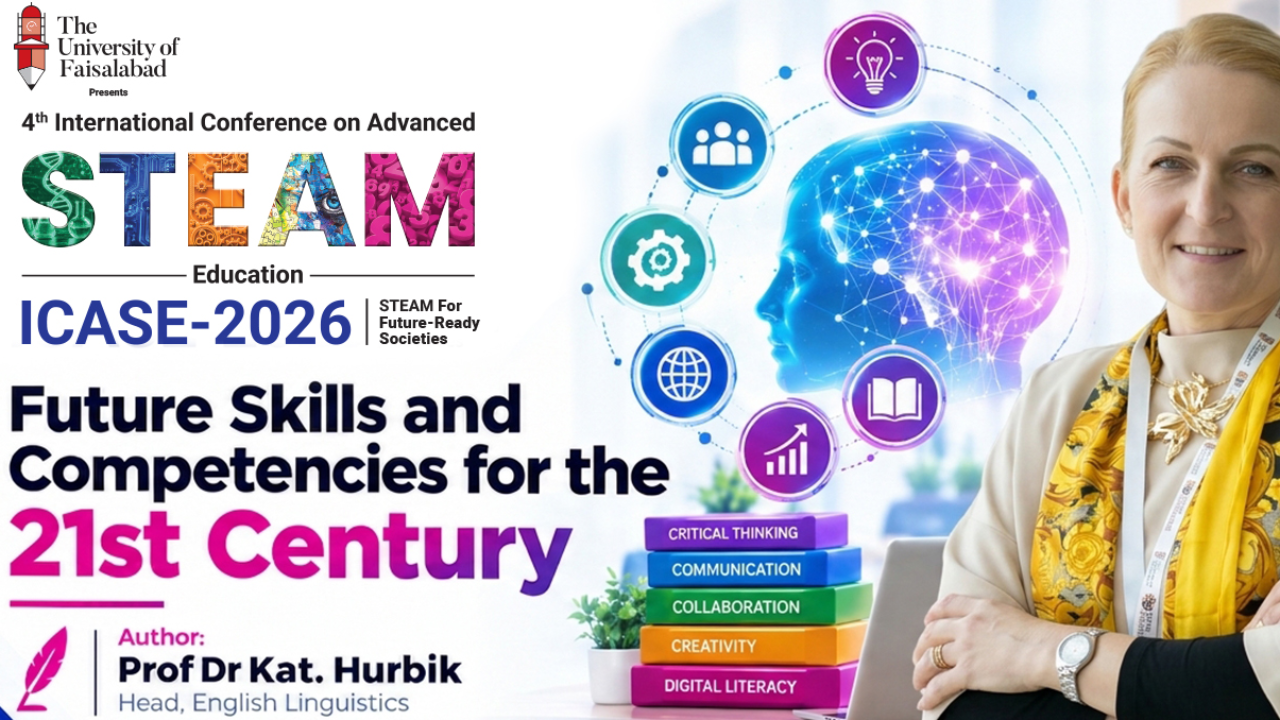
STEAM education develops critical thinking, creativity, digital literacy, collaboration, and problem-solving skills, helping students adapt to emerging technologies and changing professional demands.
Interdisciplinary skills enable individuals to combine knowledge from different fields, address complex challenges, and develop innovative solutions in rapidly evolving industries.
ICASE-2026 brings together educators, researchers, and professionals to exchange perspectives on interdisciplinary learning, emerging competencies, and educational approaches for future-ready societies.