

Islamic Intellectual Heritage and STEAM Education: A Vision for Future-Ready Societies at ICASE-2026
Analyzing how Islamic research, moral values, and scientific progress could promote a responsible future
Centuries before modern research labs and digital technologies appeared, scholars around the Islamic world were investigating mathematical ideas, studying human anatomy, monitoring celestial movements, and designing buildings that still spark scholarly interests.
Their accomplishments were a reflection of a tradition that frequently combined artistic expression, philosophical reasoning, and scientific investigation.
This intellectual legacy raises an important dilemma today as biotechnology, artificial intelligence, and other cutting-edge technologies transform society: How can the pursuit of scientific advancement remain connected to ethical duty and human welfare?
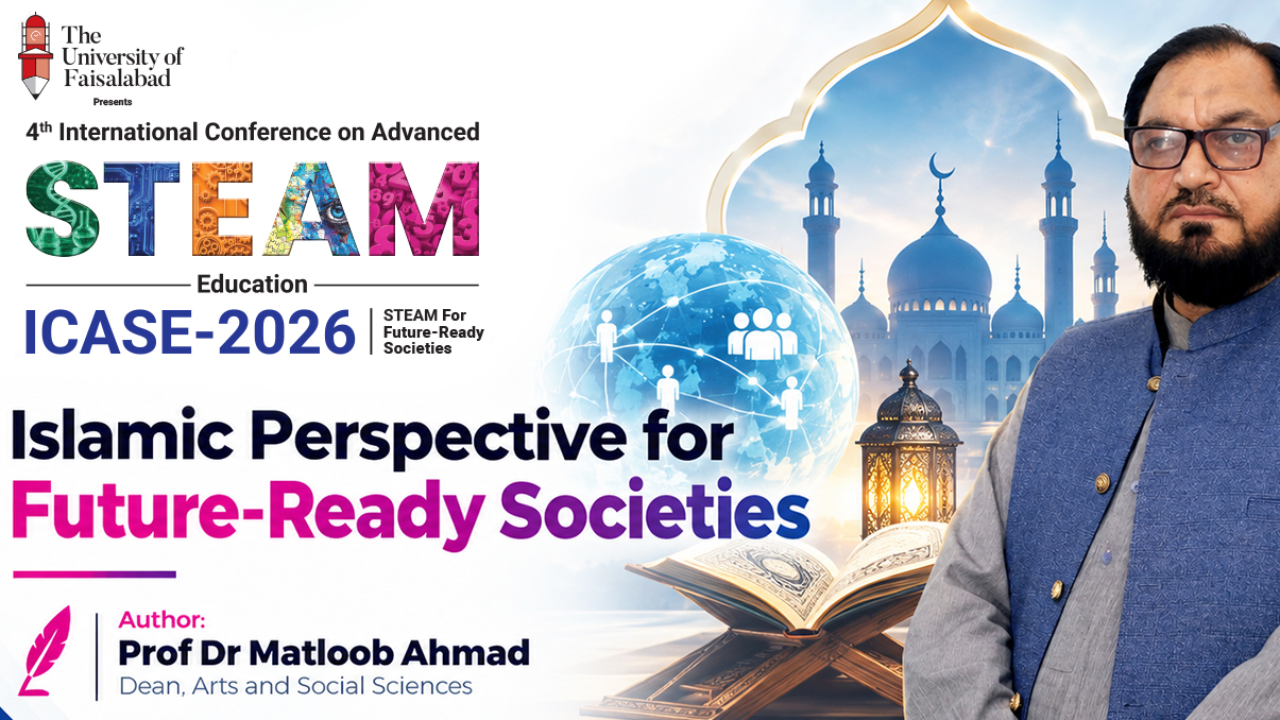
This relationship between knowledge, values, and progress is the focus of the theme of “Islamic Perspective for Future-Ready Societies” during the 4th International Conference on Advanced STEAM Education (ICASE-2026), which is being held at The University of Faisalabad (TUF).
When Knowledge Transcended Disciplinary Boundaries
The history of scientific progress in Islamic civilization provides examples of scholars whose contributions covered a wide range of fields.
Muhammad ibn Musa al-Khwarizmi's development of algebra and mathematical methods influenced later scientific investigations. While Ibn al-Haytham advanced the study of optics through research into light and perception, Ibn Sina's medical works were influential in medical education throughout numerous regions.
Research, translation, observation, and cross-cultural idea exchange all had an impact on the intellectual environments in which these scholars operated.
Their contributions also emphasize how crucial it is to look into complex problems using a variety of disciplines.
This approach is closely related to STEAM education, which integrates science, technology, engineering, the arts, and mathematics to foster interdisciplinary learning and problem-solving.
Despite the fact that STEAM is a contemporary educational paradigm, historical examples of interdisciplinary research can provide illuminating perspectives on the relationship between mathematical reasoning, artistic expression, and scientific investigation.
Is It Possible to Separate Ethical Responsibility from Scientific Progress?
Thanks to technology advancements, humanity is now better able to collect data, treat patients, automate processes, and alter natural resources.
The ability to develop a technology does not, however, ensure that its use will be beneficial, fair, or socially conscious.
Consider AI systems in the healthcare industry. Their development requires advanced computational methods and medical knowledge, even as their application poses issues with patient privacy, justice, accountability, and treatment access.
Islamic ethical perspectives offer ideas that could facilitate these kinds of discussions, such as maslahah (public welfare), amanah (trust and accountability), and adl (justice).
These regulations promote thinking about the effects of choices and the obligations that people and organizations have to the community.
Environmental sustainability raises similar issues. While Islamic teachings about moderation and waste avoidance offer an ethical viewpoint on responsible consumption, scientific innovation can enhance resource management and energy efficiency.
Scientific analysis is not replaced by the inclusion of various points of view in academic discourse. Rather, it encourages experts and scholars to consider the wider human implications of their work.
ICASE-2026: Bringing Intellectual Heritage into the Future-Ready Dialogue
International academic conversations can benefit from viewpoints that link scientific advancement with cultural awareness and ethical contemplation as the globe faces more complicated technical and social concerns.
"Islamic Perspective for Future-Ready Societies" is one of ICASE-2026's subject areas under the overall theme "STEAM for Future-Ready Societies," acknowledging the importance of Islamic intellectual traditions to current debates on education, innovation, and societal development.
ICASE-2026: Bringing Intellectual Heritage into the Future-Ready Discussion
Under the overarching theme "STEAM for Future-Ready Societies," "Islamic Perspective for Future-Ready Societies" is one of ICASE-2026's subject areas, recognizing the significance of Islamic intellectual traditions to contemporary discussions on education, innovation, and societal development.
Explore Islamic Perspectives on Future-Ready Societies at ICASE-2026
Examine the connections between responsible scientific innovation, multidisciplinary education, and Islamic intellectual legacy with scholars, educators, and researchers.
Frequently Asked Questions
Islamic intellectual heritage includes historical contributions to mathematics, medicine, optics, architecture, and scientific inquiry, offering valuable examples of interdisciplinary scholarship.
Principles such as justice, accountability, responsibility, and public welfare offer ethical perspectives for evaluating scientific advancement and its effects on society.
The Islamic Perspective for Future-Ready Societies theme encourages academic dialogue on the relationship between intellectual heritage, ethical responsibility, contemporary education, and scientific innovation.