

Policy, Leadership and Governance: The Role of STEAM in Future-Ready Societies at ICASE-2026
What makes a society truly future-ready? Is it the capacity of its leaders to effectively address new issues, the strength of its institutions, economic growth, or technological advancement?
The link between strong leadership, the rule of law, institutional accountability, and well-informed decision-making holds the key to the solution rather than any one accomplishment.
More than just administrative skills are needed for governance as countries negotiate the challenges of artificial intelligence, public health, climate change, digital transformation, and economic growth. It demands leaders who can protect fundamental rights, understand their ethical and legal responsibilities, assess scientific evidence, and create policies.
Legally speaking, technical advancement and economic growth must take place within frameworks that provide accountability, equity, equality, and openness. Strong institutions, constitutional principles, and evidence-based governance are necessary to protect individuals' rights while enabling countries to adapt to changing global realities.
Therefore, the crucial question is not just how societies might progress, but also how responsible leadership, government, and the law can ensure that development is equitable, inclusive, sustainable, and accountable.
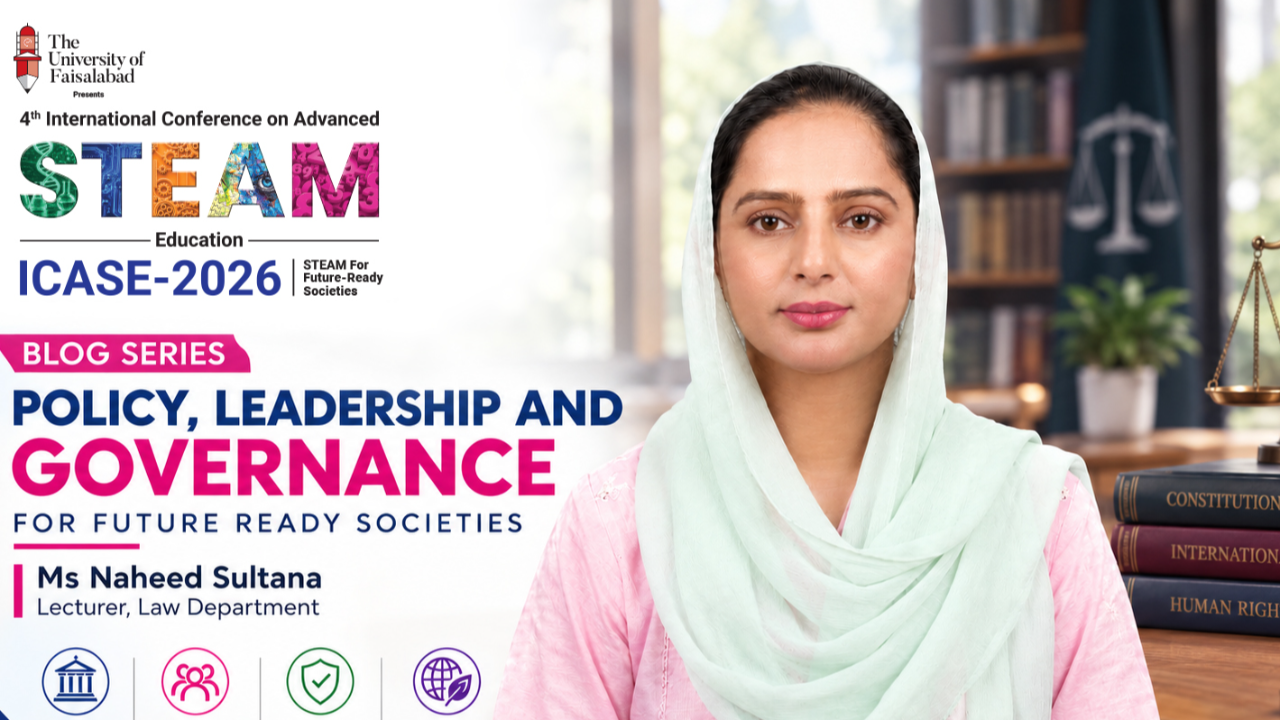
The conference theme "Policy, Leadership and Governance for Future-Ready Societies" at The University of Faisalabad's 4th International Conference on Advanced STEAM Education (ICASE-2026) is based on this point of view.
Bridging Innovation and Responsible Governance
Technological innovation cannot assure societal improvement on its own without sufficient rules, legal protections, and institutional responsibility. If advanced solutions disregard accessibility, public needs, and fundamental rights, they may result in inequity.
To establish successful governance, policymakers must assess the moral, legal, and social implications of innovation while upholding transparency and equal opportunity.
The multidisciplinary STEAM approach makes this process easier by combining scientific facts, technological know-how, analytical thinking, and human-centered viewpoints. When paired with the rule of law, these disciplines help create inclusive, evidence-based policies that balance innovation, justice, and the public good.
The Leadership Skills That Future Societies Will Demand
Three skills are especially crucial: evaluating the long-term effects of institutional actions, involving stakeholders with diverse viewpoints, and interpreting trustworthy facts.
Both public and commercial businesses can benefit from these skills.
Through multidisciplinary research, cooperative projects, policy discussions, and chances for students to investigate actual institutional and societal difficulties, higher education institutions can support the development of such leadership.
Educational institutions can help students understand the connection between leadership and scientific literacy, ethical reasoning, and social accountability instead of viewing it only as a management duty.
Can Governance Keep Pace with Innovation?
Technology frequently advances more quickly than the regulations put in place to control its usage.
AI-powered systems are being investigated more and more for use in healthcare administration, public service delivery, educational evaluation, and administrative decision-making. These apps may increase productivity, but they also bring up issues with accountability, privacy, transparency, and possible prejudice.
Clear guidelines for the assessment, monitoring, and application of such technologies must be established by a responsible governance framework.
Research should inform effective policies, but they should also be flexible enough to accommodate new information and evolving conditions.
Crucially, technical performance and financial gains should not be the only criteria used to assess innovation. Fairness, accessibility, public trust, and institutional accountability are all equally important factors.
ICASE-2026: A Platform for Policy Dialogue and Future-Ready Leadership
As countries negotiate rapid technological and social change, more emphasis should be paid to the link between research, leadership, and governance.
The 4th International Conference on Advanced STEAM Education (ICASE-2026) offers a global venue for investigating how transdisciplinary education and research might influence leadership practices and policy creation under the overarching subject "STEAM for Future-Ready Societies."
Researchers, educators, legislators, institutional leaders, and business professionals are invited to share their perspectives on evidence-based governance, responsible innovation, leadership development, and institutional decision-making under the theme area "Policy, Leadership and Governance for Future-Ready Societies."
ICASE-2026, which is set for November 2–3, 2026, will offer panel discussions, technical sessions, international keynote addresses, and networking opportunities.
The conference's hybrid mode encourages participation from both domestic and foreign countries, offering chances for scholarly and professional interaction.
A significant aspect of STEAM education is highlighted by the inclusion of policy and governance in the conference's thematic areas: its applicability goes beyond classrooms and labs to the organizations and choices that affect society.
The Future Depends on the Decisions We Make Today
By promoting multidisciplinary knowledge, critical thinking, creative approaches, and ethical awareness, STEAM education can facilitate in this process.
The distribution of technologies' advantages and the management of their hazards will continue to depend heavily on the caliber of leadership and governance.
Researchers, educators, and decision-makers come together for ICASE-2026 to discuss the policies, leadership skills, and governance strategies required to translate.
Participate in the ICASE-2026 Policy and Leadership Discussion
Examine fresh viewpoints on evidence-based policymaking, STEAM-informed leadership, and responsible governance for societies prepared for the future.
Frequently Asked Questions
STEAM education develops interdisciplinary thinking, evidence-based reasoning, communication, and creative problem-solving skills that support informed leadership and decision-making.
Responsible governance helps ensure that emerging technologies are developed and implemented with appropriate consideration for transparency, accountability, fairness, and public welfare.
ICASE-2026 provides an academic platform to explore STEAM-informed leadership, evidence-based policymaking, institutional governance, and responsible innovation for future-ready societies.