

From Climate Challenges to Green Solutions: Advancing Sustainability Through STEAM at ICASE-2026
How green innovation and multidisciplinary research may help create a sustainable future
What if a student creates a solution to an issue in their local community to lead to the next major advancement in environmental sustainability?
A structure that uses less energy, an irrigation system that uses less water, or a creative way to turn trash into valuable resources could all start out as a straightforward research proposal. However, these advancements have the potential to solve environmental issues that impact millions of people.
The need for workable, reasonably priced, and sustainable solutions is only going to increase as climate worries worsen. Understanding environmental issues is no longer the only challenge. It is about creating breakthroughs that have quantifiable impact.
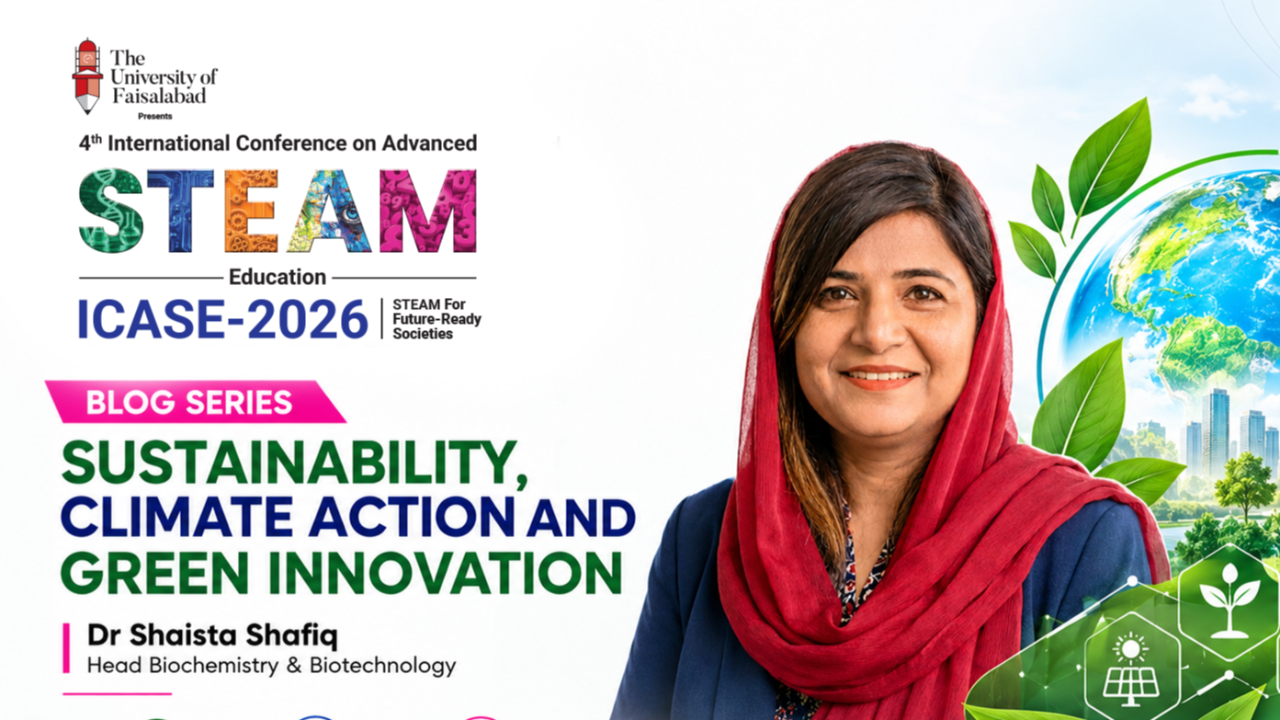
The University of Faisalabad is hosting the 4th International Conference on Advanced STEAM Education (ICASE-2026), and one of its themes is "Sustainability, Climate Action and Green Innovation." This is the main topic of discussion.
Can Innovation Affect How We Address Climate Issues?
Think about the environmental challenges that quickly expanding cities confront, such as rising energy use, water scarcity, challenges with waste management, and deteriorating air quality.
Every obstacle gives scholars and inventors the chance to reconsider traditional methods.
Technology experts may create systems that track resource usage, engineers can create energy-efficient structures, and environmental scientists can look for ways to reduce pollution. Architects, designers, and communication specialists can assist in converting these innovations into solutions that communities can comprehend and utilize in the interim.
The strength of Science, Technology, Engineering, Arts, and Mathematics (STEAM), where various fields work together to solve a common problem, is reflected in this combination.
For instance, installing solar panels is only one aspect of constructing a sustainable urban area. It necessitates comprehending energy usage, assessing environmental factors, building effective infrastructure, and designing public areas that cater to human requirements.
Connecting technical innovation with careful design and community involvement is essential to the success of such efforts.
Beyond the Lab, Green Innovation Starts
Everyday encounters give rise to some of the most pertinent environmental questions.
How can farmers reduce water consumption without compromising output? Is it possible to turn agricultural waste into usable materials? How might more intelligent infrastructure help universities use less energy?
Students, researchers, and business owners can use these questions to create solutions that are based on regional needs.
By establishing connections between academic research and businesses, environmental organizations, and communities, universities can facilitate this process. Transforming research discoveries into applications can be facilitated by interdisciplinary projects, innovation-based learning, and practical experimentation.
The potential for environmental innovation is greatly increased when the arts are incorporated into STEAM. The development and adoption of environmental solutions can be influenced by sustainable product design, architectural planning, visual communication, and behavioral insights.
A successful green technology should do more than just function well. It should also be suitable for the populations it serves, affordable, and easily accessible.
Bringing Global Perspectives to ICASE-2026
Environmental issues transcend disciplinary and geographic boundaries. Solutions created in one area could provide insightful information in another, especially when researchers have the chance to share expertise and investigate alternative methods.
Sustainability is one of the key topics influencing education and innovation in the future, according to ICASE-2026's overarching theme, "STEAM for Future-Ready Societies."
The conference's "Sustainability, Climate Action and Green Innovation" theme offers chances to share research, discuss new ideas, and look at cutting-edge methods in fields like resource conservation, renewable energy, sustainable infrastructure, environmental technologies, and climate-responsive education.
Policymakers, academics, businesspeople, and researchers can all offer viewpoints that link scientific advancements to the real-world requirements of sustainable development.
ICASE-2026, which will take place on November 2–3, 2026, will offer a hybrid platform for participation from both domestic and foreign countries, promoting communication between academic and professional sectors.
The Next Green Innovation May Start with a Concept
The effectiveness of technology to solve actual issues is what defines environmental progress rather than the quantity of technologies created.
A significant contribution to sustainability can be made by a research effort that increases water efficiency, a design that minimizes material waste, or a technical advancement that increases the accessibility of renewable energy.
STEAM education can assist in turning such concepts into real-world opportunities through multidisciplinary study and teamwork.
The discussion at ICASE-2026 shifts from identifying climate concerns to investigating the solutions that can help solve them.
Discover Green Innovation at ICASE-2026
Learn about research viewpoints, establish connections with multidisciplinary specialists, and participate in conversations about climate action and sustainability.
Frequently Asked Questions
STEAM education connects scientific research, engineering, technology, and creative design to develop practical solutions for environmental protection, resource conservation, and sustainable development.
Green innovation supports the development of renewable energy systems, sustainable infrastructure, resource-efficient technologies, and environmentally responsible practices.
The Sustainability, Climate Action and Green Innovation theme provides opportunities to discuss environmental research, sustainable technologies, climate-responsive solutions, and interdisciplinary approaches to green development.