

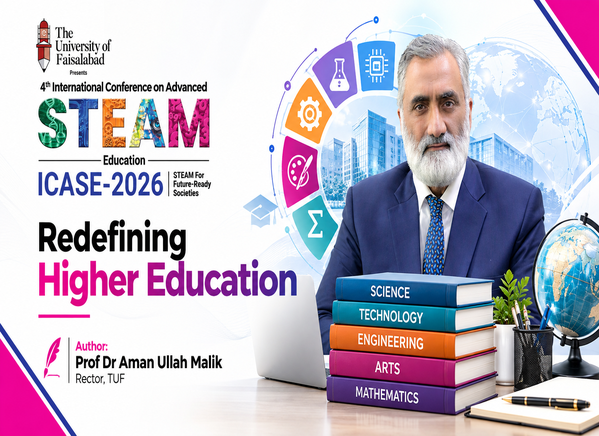
Redefining Higher Education at the 4th International Conference on Advanced STEAM Education (ICASE-2026): Moving from Disciplinary Silos to Integrated STEAM Ecosystems
Why Technical Expertise Needs a Broader Perspective
For decades, higher education was built on rigid specialization. Engineers were taught strictly technical formulas. Computer scientists focused purely on code. Arts and humanities students operated in completely separate buildings, studying culture and human behavior in isolation.
That model is obsolete.
Consider modern technological challenges:
- Building an AI medical diagnostic tool isn't just a software engineering problem; it requires deep clinical accuracy (Smart Health Care Systems), rigorous data ethics (Next Generation Edu-Tech & Ethics), and intuitive human design (Arts, Creativity, and Human-Centered Innovation).
- Designing sustainable urban infrastructure requires environmental science, supply chain logistics, and social empathy for the communities living there.
A purely technical solution without human design lacks usability. An artistic idea without technical execution lacks scale. True innovation happens exclusively at the intersection.
The Pedagogy of ICASE-2026: Re-engineering Higher Education
As Rector of The University of Faisalabad, my goal for the 4th International Conference on Advanced STEAM Education is to model how higher education curricula must evolve.
Building on the experience of ICASE 2025, which broadened technical discussions by incorporating perspectives from the social sciences, ICASE-2026 advances an interdisciplinary approach across nine key thematic areas.
Key Dimensions of an Integrated STEAM Approach
At ICASE-2026, we are exploring four important areas that can help shape the future of teaching and learning in higher education:
- Human-Centered Innovation: Technology is most meaningful when it responds to real human needs. By bringing design thinking, creativity, and the humanities into technical research, we can encourage solutions that are not only innovative but also relevant and useful to society.
- Ethics and Emerging Educational Technologies: As digital technologies become increasingly part of education, questions around privacy, automated learning, data use, and algorithmic bias require careful attention. Innovation must move forward alongside responsible and ethical practice.
- Values and Social Responsibility: Through the Islamic Perspective for Future-Ready Societies track, ICASE-2026 provides an opportunity to explore how ethical values, equity, and social responsibility can inform scientific and technological progress in changing societies.
- Equity, Inclusion, and Well-Being: The future of education should consider not only what students learn, but also how they learn and thrive. Inclusive access, supportive learning environments, and the well-being of students and educators are essential to creating sustainable educational systems.
A Call for Interdisciplinary Engagement
ICASE-2026 invites academicians, researchers, and students to look beyond the boundaries of their individual disciplines. Technical researchers can benefit from conversations with social scientists, health professionals, educators, designers, and other fields, just as these disciplines can gain from engaging with advances in science and technology.
The goal is not to move away from deep subject expertise, but to connect it with diverse perspectives across science, technology, engineering, arts, and mathematics. By bringing different areas of knowledge into conversation, we can create learning and research environments that prepare students to respond thoughtfully and effectively to the complex challenges of the future.