

From Conference Research to Scholarly Impact: Advancing Research and HEC-Aligned Publications through ICASE-2026
Moving Beyond Conference Presentation
An international conference should not be the final destination of research[cite: 1]. Presenting a paper provides an opportunity to share findings, receive academic feedback, and engage with researchers working on similar questions[cite: 1]. The real value, however, comes from what happens after that presentation[cite: 1].
For researchers, particularly graduate students and early-career scholars, a conference can be an important step in developing a research idea into a stronger manuscript, a peer-reviewed publication, a research collaboration, or even an innovation with practical value[cite: 1].
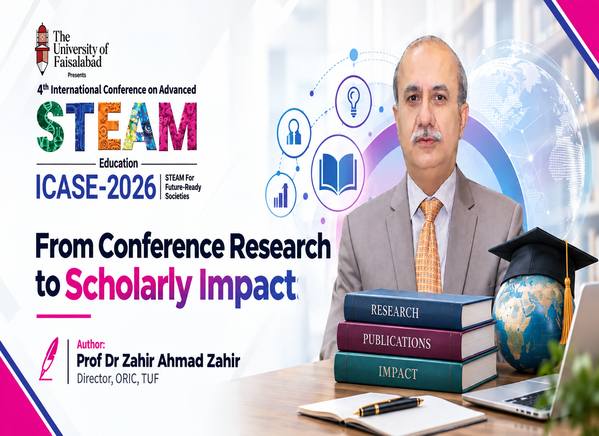
This is the perspective ORIC is bringing to ICASE-2026, the 4th International Conference on Advanced STEAM Education, being held on November 2–3, 2026, under the theme “STEAM for Future-Ready Societies.”[cite: 1]
Our aim is to support a research journey that does not stop at presenting an abstract[cite: 1]. We want researchers to have a clearer pathway from research idea to conference presentation, academic feedback, manuscript development, peer review, and publication[cite: 1].
Connecting Research with Real-World Priorities
Research becomes more meaningful when it responds to questions that matter to society, industry, education, healthcare, and the environment[cite: 1].
The multidisciplinary nature of ICASE-2026 provides researchers with an opportunity to examine these challenges from different academic perspectives[cite: 1]. Areas such as artificial intelligence and digital transformation, future skills, sustainability, climate action, healthcare innovation, biotechnology, education, and emerging technologies are increasingly interconnected[cite: 1].
For ORIC, this interdisciplinary dimension is important[cite: 1]. A strong research project may begin within one discipline but it is better to find greater relevance when its findings are considered alongside perspectives from another field[cite: 1].
The conference therefore provides a platform for researchers to present work that contributes to current global and local priorities while opening opportunities for academic discussion and collaboration[cite: 1].
Research Quality Comes First
Publication should not be treated simply as the final administrative step after a conference[cite: 1].
A publishable research paper begins with a meaningful research question, an appropriate methodology, reliable data, sound analysis, and a clear contribution to existing knowledge[cite: 1]. Researchers should also pay close attention to research ethics, accurate citation, originality, authorship, and responsible use of data[cite: 1].
For those preparing their submissions to ICASE-2026, I encourage researchers to look beyond the abstract and consider the complete research story[cite: 1]:
- What problem does the study address?[cite: 1]
- Why is the problem important?[cite: 1]
- What methodology has been used?[cite: 1]
- What evidence supports the findings?[cite: 1]
- How does the research contribute to existing knowledge?[cite: 1]
- What are its practical or academic implications?[cite: 1]
- What further research can emerge from the study?[cite: 1]
These questions can help researchers strengthen their work before it reaches the peer-review stage[cite: 1].
Turning Conference Feedback into Better Research
One of the most valuable aspects of an academic conference is the opportunity to discuss research with people outside one's immediate research environment[cite: 1].
A question from a keynote speaker, a suggestion from another researcher, or a discussion during a poster presentation can reveal a limitation, suggest another interpretation, or identify an area that deserves further investigation[cite: 1].
This is why the Poster Competition and research presentations at ICASE-2026 should be viewed as opportunities for scholarly exchange rather than simply presentation activities[cite: 1].
Feedback received during the conference can help researchers refine their arguments, improve their analysis, strengthen their discussion, and prepare their work for a subsequent journal submission[cite: 1].
For young researchers and postgraduate students especially, these interactions can also be the beginning of academic networks and future research collaborations[cite: 1].
A Publication Opportunity Through Innovations in STEAM: Research & Education
An important part of this research-to-publication pathway is the opportunity connected with TUF’s research journal, Innovations in STEAM: Research & Education[cite: 1].
The journal is recognized by the Higher Education Commission (HEC) in the “Y” Category for provides an institutional platform for research covering STEAM education, interdisciplinary scholarship, and related areas[cite: 1].
Selected papers presented at ICASE-2026 will be considered for a Special Issue of the journal, subject to the journal’s editorial and peer-review processes[cite: 1].
For eligible selected papers, publication in this Special Issue will be offered without publication charges (APC), with submissions accepted up to December 31, 2026[cite: 1].
This creates a valuable opportunity for conference participants to continue their research journey beyond the event itself: present the research, receive feedback, refine the manuscript, and submit it for peer review and possible publication[cite: 1].
Proven Research Excellence: ORIC-TUF’s Top-Tier Recognition
Our commitment to converting academic research into commercial and scholarly impact is backed by proven, national-level excellence[cite: 1]. The Office of Research, Innovation, and Commercialization (ORIC) at TUF has been awarded the prestigious "X" Category ranking by the Higher Education Commission (HEC) in its Annual Validation Report, achieving an overall score of 75/100[cite: 1]. Nationally, ORIC-TUF stands 8th overall across Pakistan and holds the 3rd spot among all private sector universities nationwide[cite: 1]. Regionally, it is ranked as the 2nd leading private university ORIC in Punjab[cite: 1].
Research, Innovation and Intellectual Property
Publication is one pathway for research impact, but it is not the only one[cite: 1].
Some research findings may have potential for technological innovation, commercial application, community impact, or intellectual property protection[cite: 1]. Researchers should therefore consider whether their work could lead to a prototype, process improvement, technology, patent, copyright, industry collaboration, or other form of knowledge transfer[cite: 1].
At the same time, researchers should consider intellectual property and disclosure requirements before publicly presenting work that may have patent or commercial potential[cite: 1].
Prepare your research with publication in mind[cite: 1]. Welcome critical feedback[cite: 1]. Follow ethical research and publication practices[cite: 1]. Explore opportunities for collaboration and innovation[cite: 1]. Most importantly, focus on producing research that contributes something meaningful to your field[cite: 1].
Through ICASE-2026 and the support of ORIC, we hope to create a stronger connection between research generation, academic exchange, peer-reviewed publication, and innovation[cite: 1].