


Generative AI, Interdisciplinary Learning and the Future of Science
“What institutional changes will be required to build a culture interdisciplinary research where STEAM Education meets the real-world challenges?”
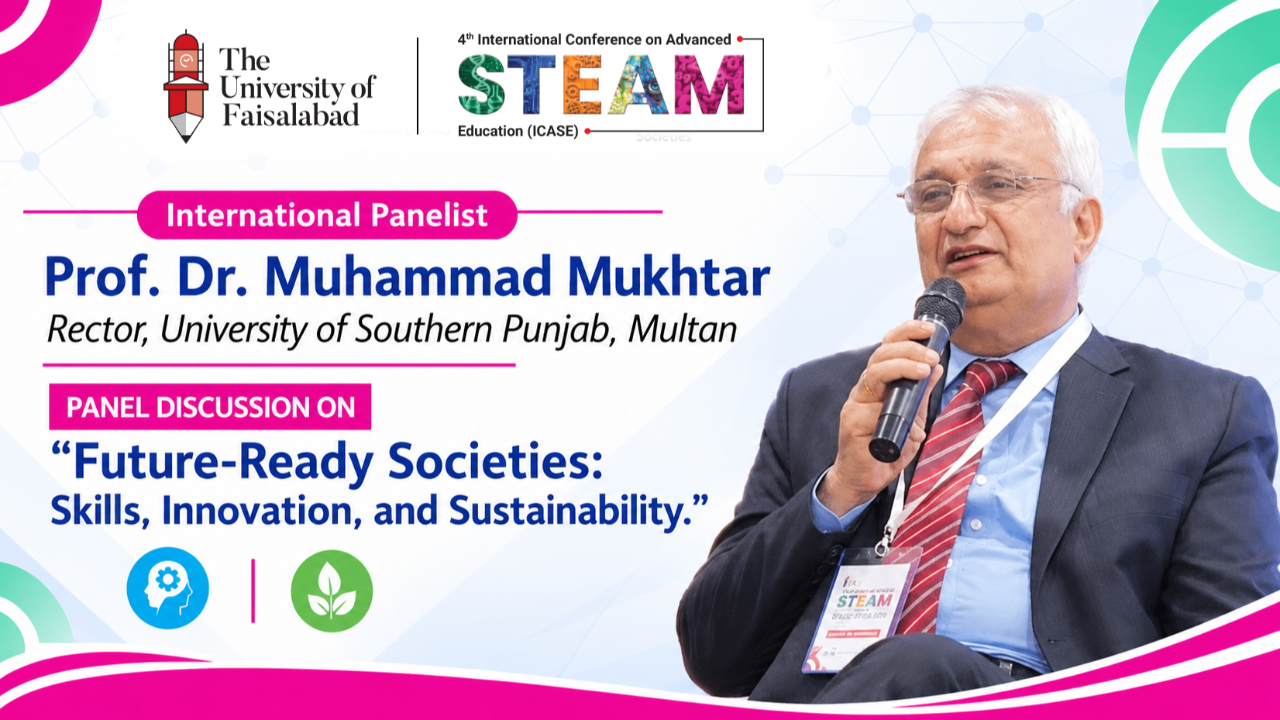
“Science is moving forward on the basis of Generative AI, and this is a revolution we must learn to navigate together.” This was among the key reflections shared by Prof Dr Muhammad Mukhtar Ahmad, Rector, University of Southern Punjab, Multan, as a strategic response to the above question asked by Prof Dr Majid Hussain, Dean, Faculty of Information Technology, TUF while moderating the panel discussion at 4th International Conference on Advanced STEAM Education hosted by TUF.
In the beginning, he congratulated The University of Faisalabad for successfully organizing 4th STEAM conference, he re-quoted the statement made by Dr Muhammad Haider Amin, Chairman BOG, TUF, in his inaugural address, about how even flies learn their flight paths. Based on this insight, he underlined that education is essential to advancement and that organizations and people must constantly adjust to shifting circumstances.
He described the current era as a time of revolution and specifically emphasized the revolutionary power of generative AI. But his talk also highlighted the possible repercussions of using AI without adequate knowledge, moral discernment, and human oversights.
He cited examples involving Generative AI and it’s interactions with vulnerable people that were covered in the media to highlight these worries. He recounted a situation he connected to an article in The New York Times in which a woman seeking counsel about her health problem allegedly got false information concerning her doctor’s recommended course of action from ChatGPT. Referencing the debates surrounding AI companion platforms like Character, he also expressed concerns about damaging chatbot responses to those who express suicidal thoughts.
These illustrations were a part of his larger contention that professional competence, accountability, and critical thinking must coexist with technological growth. Artificial intelligence cannot take the place of trained medical personnel or the discretion needed in delicate human circumstances.
Returning the conversation to interdisciplinary education, he emphasized the importance of learning from one another. He emphasized the need for medical professionals to comprehend technology advancements in order to effectively utilize new healthcare solutions, citing telemedicine as an example. Professionals may be less able to take advantage of technology if they are unfamiliar with it.
This viewpoint contributed significantly to the discussion of future-ready societies at ICASE-2026: multidisciplinary learning, responsible innovation, and ongoing knowledge sharing must coexist with scientific and technical advancement.