


Beyond Chatbots: Rethinking University Education in the Age of AI
With AI transforming almost every profession, how should universities redesign teaching practices, assessment systems and curricula to prepare graduates for careers that do not yet exist?
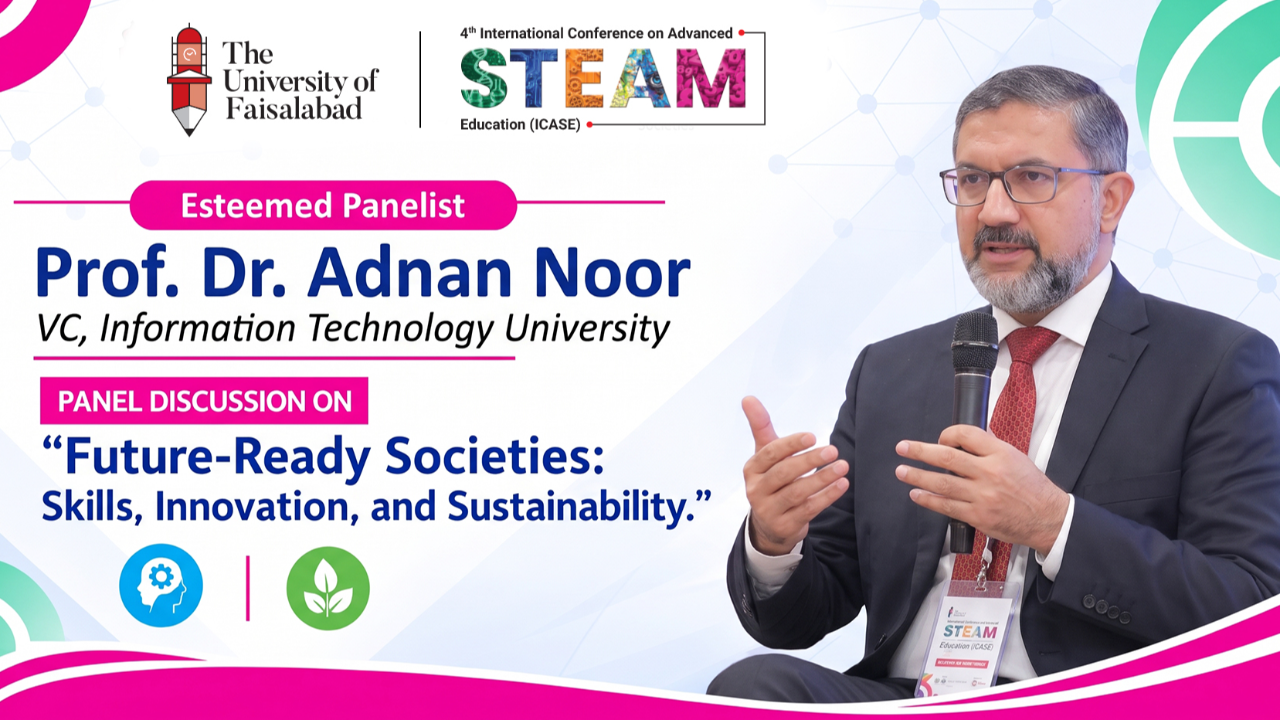
“Chatbots are just one aspect of Artificial Intelligence; there are many other forms that are equally important but often remain outside our discussions.” This was a key observation shared by Prof Dr Adnan Noor, Vice Chancellor of Information Technology University, in response to the above question posed by the session moderator, Dr Majid Hussain, Dean, Faculty of Information Technology, TUF, during the strategic panel discussion at ICASE-2026.
Highlighting the broader scope of Artificial Intelligence, Prof Dr Adnan Noor explained that AI extends well beyond conversational tools such as ChatGPT. He referred to technologies including computer vision, natural language processing, autonomous systems, pattern recognition, machine learning and deep learning. Illustrating their practical applications, he discussed how machine learning and deep learning are used in physics research to analyse massive datasets generated through particle collisions at CERN, the European research organisation. Such applications demonstrate that different fields require specialised AI technologies rather than relying exclusively on chatbots.
He further connected the evolution of AI with the changing responsibilities of university faculty. Reflecting on previous industrial revolutions, he noted how academic responsibilities expanded from teaching to research and entrepreneurship. However, the current AI-driven transformation calls for a deeper reconsideration of these responsibilities, rather than simply adding more tasks to existing academic roles.
Another important distinction in his remarks was between capability and competence. While AI is increasing what individuals can accomplish, greater technological capability does not necessarily translate into professional competence. This distinction highlights the importance of developing critical judgement, practical understanding and the ability to apply knowledge effectively.
Concluding his perspective, he emphasised that the role of universities becomes even more significant in the age of AI, particularly in providing the knowledge, human development and professional competencies that artificial intelligence cannot fundamentally replace.
His contribution at ICASE-2026 highlighted an important consideration for higher education: preparing graduates for an AI-driven future requires more than introducing digital tools into classrooms. It demands a deeper transformation in academic practices, faculty responsibilities and the development of human competencies.